Listening and the Integration of the Self
Writing this, I am here in Varanasi, reflecting on death and impermanence at the Ganges’ Dashashwamedh Ghat for the Aarti ritual. This is part of a three-week trip in India where I am visiting a lot of holy spiritual Buddhist and Hindu sites, and it’s bringing me a lot of higher-level reflections, including on the nature of intuition and consciousness.

One thing that I’ve been thinking about is finding a medium to communicate my ideas and reflections about listening as a state of consciousness. In fact, I’m thinking maybe I should publish a book, probably boringly called, “Listen” (it’s probably already taken, though).
I think what I’m trying to do is to expand people’s lay understanding of the concept of listening. I don’t mean listening only in the sense of “listen to what people are telling you” or “empathetic listening”. I also mean it in the sense of “listen to the social and physical cues in your environment”, “listen to your intuition and your unconscious brain”, and even, “listen to what life is trying to tell you, through whatever coincidences and synchronicities arise”. It is also as a way to see mindfulness and paying attention more generally as a form of “listening”. So perhaps we could talk about “deep listening”, in the sense of listening to cues that are usually too subtle to detect, but that nonetheless carry rich and useful information. This might make you better at pattern detection.
I’m feeling ambitious these days. I also want to write about “The Integrated Self”, or something like that. Like mindfulness integrating different parts of the self / brain, mirroring gamma synchrony during mindfulness (Lutz et al., 2004). Perhaps it could be part of the same book (i.e., listening to one’s intuition helps get a more integrated self with the non-verbal side of the brain)1.
So, yes, the integrated self book will be about integrating the left and right hemispheres, the verbal consciousness with the non-verbal one, discussing the implications of a severed corpus callosum—the arc-like bundle of nerves at the middle of the brain that bridges the two hemispheres2. I know most of us still have an intact corpus callosum, but I still think different brain regions are not as harmoniously integrated by default as they could be, and that this can be learned or developed. Perhaps it could fit in the same book as “Listen”, or a different book, I’ll see.
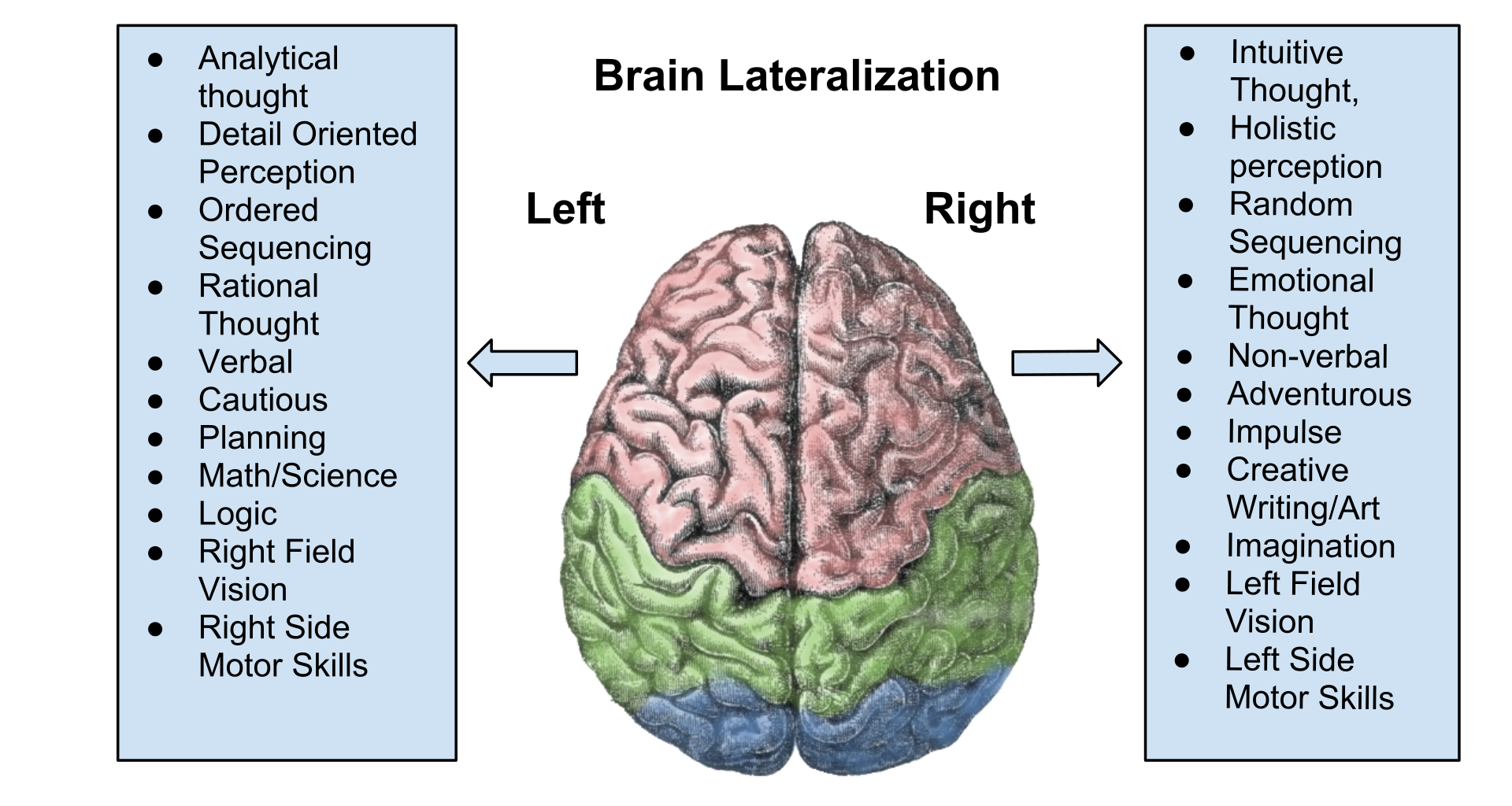
Now, what do I mean by the “integrated self”? I am talking about an harmonious integration of conscious / controlled and unconscious / automatic processes. The way we discuss this in psychology is typically as “System 1” (fast and automatic) and “System 2” (slow and controlled), and we describe those two systems as usually well-integrated. However, my assertion is that we all have a hidden potential that is, for the most part, “untapped”, but that can be discovered by using system 2 to pay attention to system 1.
Some of this inter-system activity is also already automatic, and perhaps even harmonious, especially in the case of well-developed habits. You might have already realized that with good sleep habits, you may start to wake-up right before your alarm clock, hinting at some kind of internal clock. Similarly, after training myself to take power naps of 20 minutes (with a timer), I find that now I frequently wake-up right before the 20 minutes is up. As I progressively regain consciousness, I can feel my heart beat, body sensations, and mental activity slowly going back to normal. Still that internal clock getting some work done.
Sometimes, however, that internal clock might work even in non-habitual contexts. For me, for instance, it used to take the form of waking up before my bus stop, as I would fall asleep during the ride, being too exhausted from long school days. Clearly, given that this decision is accurate, the “decision” of your unconscious brain to wake you up at a particular point in time must be based on something. At times, this can be the internal clock, but at other times, this might be due to external stimuli within the environment.
Cocktail Party Effects: Where Conscious Meets Unconscious
Humans have a rather impressive ability to selectively attend to specific cues, such as a discussion at a loud party, while ignoring all the other discussions around. Remarkably, however, we also tend to pick-up on other conversations from across the rooms if our name is said. This surprising effect is called the “cocktail party effect”.
What I think is most remarkable about it is that it suggests that when focusing, it is not that we do not hear or process other conversations. In fact, for our brain to be able to “warn us” of other relevant conversations, it has to be—somehow—processing all conversations, and then selectively filtering out the relevant information. It is probably a good thing that we don’t have to do this consciously, because dealing with so many conversations at once would be overwhelming. But the brain still does it, even if we are not aware of it3.
The cocktail party effect is clasically taught simply as a particular sensitivity to our name being called, but I believe it works with any constructs relevant to our self-concept, interests, or motivation. For me, for example, in parties, it tended to manifest when someone across the room started talking about martial arts or meditation. It would only take a few seconds to make my way there and join this new exciting conversation.
I believe cocktail party effects also occur during sleep, which is probably why we are more likely to wake up from sleep when our name is called. Just during this trip, for instance, I felt like I had to come out of my nap on a flight and open an eye, and, truth be told, it was the food cart coming. Even though food is not central to my self-concept, I was hungry, thus my brain decided that was a sufficiently relevant cue for waking me up.
This is also consistent with the fact that we can integrate information from external stimuli within our dreams4, suggesting that auditory or even tactile or visual cues are continuously processed, even during REM sleep. As a funny anecdote, a common dream “problem” I used to have is that, within my dream, I would keep trying to put on sunglasses but they wouldn’t work… that’s because outside the dream, the sun really was beating down onto my bed through my windows every morning and blinding me even though I had my eyes closed.

Another example of this selective sensory processing is that when I walk and text on my phone, I might be fully focused on my phone’s screen. Yet, my body still processes the environment and “alerts me” (in the form of mental sensations) about what I need to pay attention to in the environment, such as: cool-looking landscapes, individuals of possible relevance, possible threats in the environment, people looking in my direction, but also obstacles in the environment such as holes in the ground or steps on stairs5.
In other words, I am on “autopilot texting” and walking, and not paying much attention, and yet I (somehow) manage to avoid all accidents in the road (probably because this peripheral processing is automated too). So you might say I have strong automatic peripheral vision processing. I’m pretty sure this is a visual variant of the cocktail party effect, and we might just need to explore this known effect in more depth and with more attention.
So, what’s common in all these examples? In all of those, there is some sort of relevance-based sensory filtering going on, and the conscious self only “gets the notice” for specially selected, relevant stimuli.
So based on the above, we could formulate the following hypotheses:
- The cocktail party effect works not only with one’s name, but with any important or situationally relevant sensory cue (e.g., social identity or political affiliation).
- The cocktail party effect can also occur during sleep.
- The cocktail party effect is merely an auditory version of relevance-based sensory filtering, therefore we can also have non-auditory variants, such as visual cocktail party effects.
Awareness, Mental Map, and Mind Sensations
I also noticed that many people say that I have a distinct way to speak, which mostly resolves around the timing of my break and emphasis on words, with some feeling it’s a bit of a hypnotic rhythm. In a way, if I spoke too fast, people might not understand and ask to repeat again. But by attuning to (what I perceive as) people’s natural language processing speed, people can better “savour” each word at the right amount of time, in the right proportion, relative to each other word of that sentence. This, hopefully, leads to the right understanding and emotional tone I’m trying to create. But how exactly do I “know” when to pause and emphasize? I’ve turned my attention on this to understand what exactly drives this particular discursive melody.
What I’ve observed it seems that I am simply following something I can only describe as “the path” (what’s that, you ask?). Simply put, it’s a kind of “feeling”, that shows me the rhythm to adopt. I just follow this “map”, which is non-visual, and only contains like the next second or so of “planning”. So I have to continuously pay attention to it to know when to stop my words and take breaks. In other words, I have to continuously “look at” or “listen to” the next steps to know what to do. So I think you can see here what’s happening: the conscious part of the brain is actively trying to “listen” to the (so-to-speak) unconscious side. (Now, a side quest might be to ask: how does this mental sensation “know” what rhythm to adopt? I have no clue)
Basically, one could say that this process is normally automatic, but awareness can bring this process unto focus. It is not exactly 100% spontaneous or instant, rather, I have to actively “listen” to “it”—the so-called unconscious mind, for a lack of a better word.
Regardless, at this point, I am pretty confident that I could define “intuition” in very clear operational terms, mostly around physical sensations in the body and mind. Yes, yes, mind sensations. Such as “listening to the path” as described above. Perhaps similar things are happening for musicians and improvisation, freestyle rapping, and the like.
Keep in mind that this is different from “a wild guess”, as paying attention is necessary to have (more) accurate information for decision making based on precise mind sensations (themselves based on some sort of non-verbal information), rather than just random “chance” or noise. Without paying attention (“listening”), you might in fact notice that you would have taken a decision opposite to what the path of mental sensations suggested.
I think this is actually one of my strengths; what I lack in conscious mental abilities, I make up for with a strong connection to my intuition. That’s why people sometimes have a funny perception of me: my conscious self might appear quite ordinary, but underlying that, the intuition seems to be relatively robust, so interestingly, there’s some sort of dissociation going on there. (Side note: should I add “has strong cocktail party effects” on my CV?). More seriously, I think we could investigate differences in cocktail party effects susceptibility (linked to hypnotizability? Not sure). What might be the main drivers of individual differences in cocktail party effects? One hypothesis: Dispositional listening to mental sensations, and more generally one’s ability for awareness (with the understanding of awareness as distinct from attention… the topic of another blog post I’m afraid).

And so, no, in my opinion, having a functional corpus callosum doesn’t explain differences in this ability (as we all have unless it was severed to treat epilepsy). A fully integrated self might just be a very fluid and cooperative dialogue between the conscious and unconscious mind. In other words, “inner listening” might be a necessary condition for the integrated self. And the development of this more subtle form of awareness is necessary to develop the best “listening” of these mind sensations.
I am starting to think that this is why practicing Vipassana and awareness of body sensations is so important (the topic of a future blog…), because at some point (some advanced level?), this ability is then (must be?) turned toward consciousness itself, to unlock the next level of “progress”. The only question mark is, why doesn’t S. N. Goenka (the founder of the modern Vipassana movement / tradition) talk about this explicitly? Why did I have to learn this “turning consciousness inward” from Tibetan Buddhists?
This is a breakthrough because although I have been mumbling about non-verbal thinking since 2009 (which I used to call “supra-thinking”6,7), I’ve just now tied it explicitly to Goenka’s practice and with the construct of “mental sensations”, which I find useful to describe to others as well as to integrate with our existing knowledge of the practice. On that note, be well, and may you be happy and enlightened.
Emerging synthesis
Listening appears to be the mechanism by which integration of the self happens.
Cocktail party effects may be understood as observable signatures of successful listening—both externally and internally.
These effects are not primarily about hearing names in noise, but about relevance detection.
Listening trains relevance detection.
Improved relevance detection supports greater integration.
Meditation can function as a controlled environment for training listening to internal relevance signals by quieting verbal noise.
One useful way to think about this process is as a functional “brain–mind barrier” that selectively allows relevant signals to enter conscious awareness while filtering out noise.
Footnotes
I’m not sure how the book will turn out or how exactly all the pieces of the puzzle fit in just yet, but I get excited at the idea of writing about this because writing helps clarify thinking, too. And I feel like I have a lot of organization to do with these ideas.↩︎
The impressive body of literature which I should review and fact-check↩︎
There is a nice paper which I’d like to discuss which describes how in schizophrenia, some of the “walls” connecting non-conscious but still verbal processing areas break down so all these usually unconscious thoughts actually find their way to consciousness, which can, obviously, be debilitating.↩︎
Need to add the references for this↩︎
This seems to be related to “exogenous attention”, the literature which I should also review.↩︎
I found back a 2011 Facebook post of mine in which I had written (translated from French),
↩︎The sensation came first, then the thought. But the thought wasn’t necessary; the sensation was more than enough. It had, from the outset, given me all the necessary information. The thought only served to repeat what I already knew in every cell of my being, and to weigh down and overwhelm my helpless mind…
I should also look deeper into pre-reflective processes and the Coherent Effortless Experience (CEEing) model specifically (Lieberman, 2022).↩︎